
How to Start an Export Business in Nigeria (2026 Guide)
Table of Contents
- Introduction
- Why Start an Export Business in Nigeria?
- Step 1: Assess Your Export Readiness
- Step 2: Register Your Business with the Corporate Affairs Commission (CAC)
- Step 3: Obtain Your Tax Identification Number (TIN)
- Step 4: Register with the Nigerian Export Promotion Council (NEPC)
- Step 5: Secure Product-Specific Approvals (NAFDAC, NAQS, SON)
- Step 6: Open a Domiciliary Account and Understand the NXP Form
- Step 7: Find Buyers and Negotiate Contracts
- Step 8: Handle Logistics and Shipping
- Step 9: Comply with Nigeria’s New Tax Regime
- Step 10: Reinvest and Scale Your Export Business
- Most Profitable Products for Export from Nigeria
- Advantages and Disadvantages of Export Business in Nigeria
- Common Mistakes to Avoid
- Expert Tips for Aspiring Exporters
- Frequently Asked Questions (FAQ)
- Key Takeaways
- Conclusion and Call to Action
Introduction
Yes, you can start an export business in Nigeria and the timing has never been better. Nigeria’s non-oil export sector reached a historic $6.1 billion in 2025, an 11.5% increase from the previous year. Over 1,100 new exporters entered the market in 2025 alone, proving that this is a viable and growing opportunity for entrepreneurs, farmers, and professionals alike.
Read more: 10 blogging secrets They Never Told You Until Now
The process involves registering your business, obtaining an exporter’s certificate from the Nigerian Export Promotion Council (NEPC), securing product-specific approvals, and finding international buyers. While the steps are straightforward, compliance is non-negotiable and that is where many beginners stumble.
This comprehensive guide will walk you through everything you need to know about how to start an export business in Nigeria, from legal registration to shipping your first container.
Why Start an Export Business in Nigeria?
The Nigerian export landscape has transformed dramatically. Here is why now is the time to enter:
Record-breaking growth. Nigeria exported 8.02 million metric tons of non-oil products in 2025, reaching markets across 120 countries. The top destinations were the Netherlands (17.53%), Brazil (10.35%), and India (7.63%).
Government support. The NEPC offers capacity-building programs, export incentives, and trade linkages to registered exporters. In 2025, they conducted 728 training programs reaching 96,221 participants.
Untapped agricultural potential. Nigeria is the 4th largest producer of cocoa beans globally, yet much of the value addition happens abroad. This represents a massive opportunity for exporters who process raw materials before shipping.
Growing demand for Nigerian products. Processed foods, shea-based cosmetics, leather goods, and specialty agricultural products have strong demand in the US, EU, and Asian markets.
1st Step: Assess Your Export Readiness
Before diving into registration, take a step back. Exporting is not for everyone, and starting without preparation leads to costly mistakes.
Ask yourself:
– Do I have consistent access to quality products that meet international standards?
– Am I prepared to handle documentation, logistics, and regulatory compliance?
– Do I have startup capital for registration fees, product sourcing, and shipping?
The NEPC provides an export readiness checker on their e-registration portal. Use it to evaluate your preparedness before committing resources.
- Expert Tip: Many successful exporters start by aggregating products from farmers or small producers rather than owning farms or factories. This lowers your initial capital requirement while you learn the business
Read also: If You are Starting a Blog in 2026 – Read This First
- 2nd Step: Register Your Business with the Corporate Affairs Commission (CAC)
Your export business must be a legally registered entity. The NEPC does not issue export licenses to Business Names you must register as a Limited Liability Company. This is a critical distinction that many beginners overlook.
Requirements for CAC Registration:
– Minimum share capital of ₦100,000 for private companies
– Memorandum and Articles of Association
– Proposed company name (must be available)
– Director details
If your business involves foreign shareholders, the share capital requirement increases to ₦100 million. This is a recent enforcement by the CAC that has caught many companies off guard.
Process:
- Conduct a name availability search on the CAC Company Registration Portal
- Prepare and submit Form CAC 1.1 with required documents
- Pay registration fees and stamp duty
- Receive Certificate of Incorporation (typically within 5–7 working days)
> Cost: Approximately ₦1.3 million for companies with ₦100 million share capital (required for foreign participation). Lower for local companies with ₦100,000 capital.
3rd Step: Obtain Your Tax Identification Number (TIN)
Registration with the Federal Inland Revenue Service (FIRS) is mandatory. You need a Tax Identification Number to proceed with NEPC registration and to comply with Nigeria’s new tax regime.
Under the Nigeria Tax Administration Act 2025, tax registration now applies to all businesses, even those that may not end up paying tax. Exporters must register and maintain proper tax records.
What you need:
– Certificate of Incorporation from CAC
– Completed tax registration form
– Business address and director details
4th Step: Register with the Nigerian Export Promotion Council (NEPC)
This is the most important step for how to become an exporter in Nigeria. The NEPC is the regulatory authority responsible for issuing export certificates. Without this certificate, you cannot legally export.
Documents Required (Limited Liability Company):
– Certificate of Incorporation (from CAC)
– Certified True Copy of Memorandum and Articles of Association
– Current Certified True Copy of Form CAC 1.1 (Particulars of Directors)
Registration Process:
- Visit the NEPC e-registration portal at `nepc.gov.ng/ereg/exporter/`
- Create an account with your business details
- Complete the online registration form
- Upload required documents
- Pay the registration fee
> Registration Fee: ₦13,500 for new certificate registration
Certificate Validity:
– Initial certificate valid for 2 years (24 months)
– Renewable annually thereafter
– Renewal fee: ₦7,500 (within expiry period) or ₦12,500 (late renewal after 3 months)
Benefits of NEPC Registration:
– Access to export incentives
– Capacity-building programs (trainings, seminars, workshops)
– Networking opportunities with other exporters
– Trade linkages (B2B and B2C)
– Formal recognition that builds trust with international buyers
> Important: NEPC certificates are issued within one working day after payment confirmation, provided your documentation is complete.
5th Step: Secure Product-Specific Approvals
Different products require approvals from specific regulatory agencies:
| Product Category | Regulatory Body | Required Certification |
| Food, drugs, cosmetics | NAFDAC | NAFDAC Registration/ Certification |
| Agricultural products, plants, animals | Nigerian Agricultural Quarantine Service (NAQS) | Phytosanitary Certificate |
| All products (quality standards) | Standards Organization of Nigeria (SON) | SONCAP or product certification |
| Environmentally sensitive products | NESREA | Environmental permit |
Read More: 7 Blog Traffic Mistakes That Silence 99% of New Blogs & How to Avoid Them
Relevant quote: “Quality is not negotiable if you want to compete globally. Producers must priorities safety and compliance before obtaining NAFDAC certification.” Oluwaseyi Sanwoolu, NAFDAC Director
> Expert Tip: Engage with these agencies early. Their approval processes can take time, and you do not want to secure a buyer only to discover your product cannot be certified.
6th Step: Open a Domiciliary Account and Understand the NXP Form
To receive payment in foreign currency, you need a domiciliary account with a Nigerian bank that is an Authorised Dealer.
The Nigeria Export Proceeds (NXP) Form:
This is a mandatory declaration form for all exports from Nigeria. It enables exporters to declare their products, receive payments through official channels, and repatriate foreign earnings.
Process:
- Obtain pro-forma invoice from your buyer
- Submit Form NXP to your bank (Authorised Dealer)
- Bank validates and submits to the Central Bank of Nigeria
- Proceed with shipping and documentation
> Statistic: 19,975 NXP forms were processed in 2025, and 30 commercial banks are actively facilitating export documentation.
7th Step: Find Buyers and Negotiate Contracts
This is where many aspiring exporters get stuck, they have the product but cannot find reliable buyers.
Where to Find International Buyers:
– Trade fairs and expos (local and international)
– NEPC’s trade portal and matchmaking services
– Online B2B platforms (Alibaba, Global Sources, Trade India)
– Embassies and trade attachés
– Existing exporter networks and associations
Essential Contract Terms:
– Price and payment terms (prefer Letters of Credit for security)
– Quality specifications and inspection standards
– Quantity, packaging, and delivery timelines
– Dispute resolution mechanism
> Warning: Not all buyers are genuine. Verify buyers through trade references, bank checks, or by working through established platforms.
8th Step: Handle Logistics and Shipping
Exporting involves more than just selling you must deliver the goods.
Key Logistics Partners:
– Freight forwarders handle shipping arrangements
– Clearing agents manage customs clearance at ports
– Warehousing providers store products before shipment
– Inspection agencies verify product quality before shipping
Documents Required for Shipping:
– Bill of Lading
– Commercial Invoice
– Packing List
– Certificate of Origin
– Phytosanitary Certificate (for agricultural products)
– NXP Form (validated by bank)
> Expert Tip: Partner with experienced logistics companies to reduce errors, accelerate learning, and improve operational efficiency.
9th Step: Comply with Nigeria’s New Tax Regime
The Nigeria Tax Act 2025 introduced several changes affecting exporters:
- Mandatory TIN registration for all businesses even those not paying tax
- Stricter documentation requirements maintain clear records of export proceeds and repatriation through Authorised dealers
- Digital records required tax authorities rely more on electronic systems
- Penalties for non-compliance awarding contracts to unregistered entities attracts a ₦5 million penalty
> Expert Insight: “Exporters are expected to maintain clear documentation showing the flow of export proceeds and proof that funds were repatriated through Authorised dealers.” Chioma Nwangwu, BusinessDay Tax Reporter
Incentives Available:
The Nigeria Tax Act 2025 offers Economic Development Incentives (EDI) for priority sectors including:
– Manufacturing
– Agriculture
– Pharmaceuticals
– Healthcare
– Digital content
– Chemicals
Eligible companies meeting the Qualifying Capital Expenditure (QCE) threshold are entitled to a 5% annual Economic Development Tax Credit for five years (extendable for another five years).
10th Step: Reinvest and Scale Your Export Business
Successful exporters do not stop at the first shipment.
They reinvest profits to:
– Own farms or processing facilities (improving margins)
– Secure reliable supply chains
– Expand into new markets
– Add value to raw products (processing, branding)
Relevant quote: “At Sterling Bank, we recognise that true support for the non-oil sector goes beyond merely providing capital, and requires equipping businesses with the capability to use that capital effectively in highly regulated global markets.” Akporee Idenedo, Sterling Bank
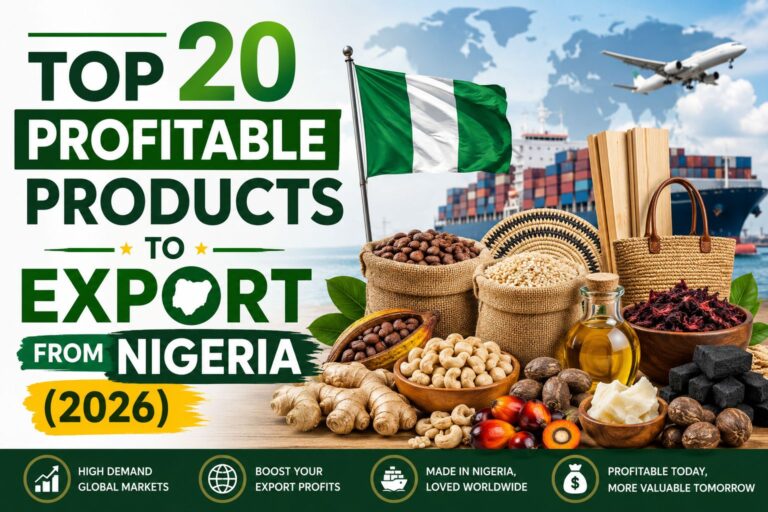
Most Profitable Products for Export from Nigeria
Based on current market data and expert analysis, these products have strong export potential:
Top Performing Products (2025 Data):
– Cocoa Beans: Nigeria’s largest non-oil export, generating $1.99 billion
– Fertilizer (Urea): contributed $1.29 billion
– Sesame Seeds: high demand in Asia and Europe
– Cashew Nuts
– Shea Butter and derivatives
– Aluminum Ingots, Copper Ingots, Rubber
Promising Products for New Exporters:
Analysts recommend focusing on products with existing production capacity and clear international demand:
– Processed and packaged foods: spices, flours, snacks, sauces
– Natural personal care: shea-based items, plant oils, soaps
– Leather goods: belts, bags, wallets (finished products preferred over raw hides)
– Semi-processed agricultural inputs: cleaned seeds, processed nuts, cocoa derivatives
– Handcrafted home décor: boutique retail and online platforms
> Critical Note: “For the non-oil export segment of our economy to realize its trade potential, we must move from exporting raw goods to exporting finished products, competing on quality and value rather than just price. “Akporee Idenedo, Sterling Bank
Advantages and Disadvantages of Export Business in Nigeria
Advantages
| Advantages | Explanation |
| Foreign exchange earnings | Income in stable currencies (USD, EUR, GBP) |
| Government incentives | Tax holidays, Export Expansion Grant, duty drawbacks |
| Growing market access | AfCFTA opens 1.3 billion consumer market |
| Diversification | Not dependent on Nigerian naira economy |
| Value addition opportunity | Processing raw materials increases profit margins |
| Job creation | Scalable business that employs others |
Disadvantages
| Disadvantage | Explanation |
| High compliance burden | Multiple regulatory agencies, each with requirements |
| Capital intensity | Significant upfront costs for certification, sourcing, shipping |
| Logistics challenges | Port delays, infrastructure issues, freight costs |
| Market volatility | Global commodity prices fluctuate |
| Quality requirements | Stringent international standards (EU, USFDA) |
| Scams and fraud | Fake buyers, payment fraud, counterfeit documentation |
Common Mistakes to Avoid
Based on real experiences and expert observations, avoid these common pitfalls:
- Starting Without Compliance Registrations
> “A lot of Nigerian businesses jump straight into dealing with foreign buyers without putting their regulatory structure in place.
In importation/exportation, passion and product are not enough. Compliance is currency.” Faith Agu, Legal Consultant
- Neglecting Product Quality
Rejected shipments at port of entry cause huge losses. Quality control is non-negotiable.
- Registering as a Business Name Instead of a Limited Liability Company
The NEPC does not issue export licenses to Business Names.
- Skipping Market Research
Exporting without understanding your target market leads to unsold products and losses.
- Dealing with Unverified Buyers
Payment fraud is common. Use Letters of Credit and verify buyers thoroughly.
- Incomplete Documentation
Documentation errors cause shipment delays, rejection, and financial loss.
- Ignoring the New Tax Regime
Failure to maintain proper records or register for TIN can result in penalties.
Expert Tips for Aspiring Exporters
1st Tip: Start Small and Scale
> “You don’t need to own a farm or factory to begin. Many successful exporters start with aggregation and export buying quality produce from farmers, processing, packaging, and shipping. With time, you can reinvest profits into owning a farm, warehouse, or processing plant.”
2nd Tip: Focus on Value Addition
Nigeria ranks 130 out of 140 countries on the Economic Complexity Index because the nation overwhelmingly sells raw materials rather than finished goods. Adding value increases margins and competitiveness.
3rd Tip : Build Strategic Partnerships
Team up with experienced logistics companies, agricultural cooperatives, export consultants, and clearing agents.
4th Tip: Leverage Government Incentives
The Export Expansion Grant (EEG), Non-oil Export Stimulation Fund (NESF), and duty drawback schemes are available use them.
5th Tip: Stay Informed
Join the NEPC’s capacity-building programs, follow market intelligence reports, and participate in trade associations.
6th Tip: Formalise Early
> “No business should remain informal. Once you formalise your operations, you open doors to bigger markets and export incentives.” Bolanle Emmanuel, NEPC Acting Regional Coordinator.
Frequently Asked Questions (FAQ)
- What is the first step to start an export business in Nigeria?
Register your business as a Limited Liability Company with the Corporate Affairs Commission (CAC). The NEPC does not issue export licenses to Business Names.
- How much does it cost to get an export license in Nigeria?
NEPC registration costs ₦13,500 for a new certificate. Additional costs include CAC registration, tax registration, and product-specific approvals.
- Is NEPC registration mandatory?
Yes. The Nigerian Export Promotion Council Act requires all exporters to register with the NEPC before commencing export activities.
- How long does NEPC registration take?
Certificates are issued within one working day after payment confirmation, provided your documentation is complete.
- What products can I export from Nigeria?
Agricultural commodities (cocoa, sesame, cashew), processed foods, shea butter and cosmetics, leather goods, solid minerals, and manufactured products. Visit the NEPC portal for the full list.
- Do I need NAFDAC registration to export food products?
Yes. Products for human consumption require NAFDAC certification before export
- What is the NXP form and why is it important?
The Nigeria Export Proceeds (NXP) form is a mandatory declaration for all exports. It enables exporters to declare products, receive payments through official channels, and repatriate foreign earnings.
- What is the minimum share capital to start an export company in Nigeria?
₦100,000 for private companies. If you have foreign shareholders, you need ₦100 million.
- How do I find international buyers for my products?
Use trade fairs, NEPC matchmaking services, online B2B platforms (Alibaba, Global Sources), embassies, and existing exporter networks.
- How long is the NEPC export certificate valid?
The initial certificate is valid for 2 years (24 months), renewable annually thereafter.
- Can I export without registering with NEPC?
No. Exporting without NEPC registration is illegal and attracts penalties.
- What documents do I need for NEPC registration?
Certificate of Incorporation, Memorandum and Articles of Association (certified true copy), and Form CAC 1.1 (Particulars of Directors).
- What are the benefits of registering with NEPC?
Export incentives, capacity-building programs, networking opportunities, and trade linkages.
- Is the export business profitable in Nigeria?
Yes. Nigeria’s non-oil exports reached $6.1 billion in 2025, with over 1,100 new exporters entering the market.
- What is the role of NAQS in agricultural exports?
The Nigeria Agricultural Quarantine Service issues phytosanitary certificates to ensure agricultural products meet international health and safety standards.
Key Takeaways
- Exporting from Nigeria is legal, profitable, and growing the sector reached $6.1 billion in 2025.
- You must register as a Limited Liability Company, not a Business Name. The NEPC does not issue licenses to Business Names.
- NEPC registration costs ₦13,500 and the certificate is valid for 2 years initially.
- Product-specific approvals are mandatory NAFDAC for food, NAQS for agricultural products, SON for quality standards.
- Compliance is non-negotiable “Compliance is currency” in international trade.
- Value addition increases profitability processed products earn higher margins than raw materials.
- Start small, aggregate, and scale you don’t need to own farms or factories to begin exporting.
- Government incentives are available leverage the Export Expansion Grant, tax holidays, and capacity-building programs.
- Nigeria’s new tax regime requires strict documentation maintain records of export proceeds and TIN registration.
- The African Continental Free Trade Area (AfCFTA) unlocks 1.3 billion consumers Nigerian exporters have unprecedented market access.
Conclusion and Call to Action
Starting an export business in Nigeria is one of the most viable pathways to wealth creation and economic diversification. With the sector hitting record highs of $6.1 billion in non-oil exports, over 1,100 new exporters entering the market in 2025, and government-backed incentives available, the opportunity is real.
The process is straightforward: register your business with the CAC, obtain your Tax Identification Number, register with the NEPC, secure product-specific approvals, find buyers, and ship.
But success demands more than just ticking boxes. It requires compliance, quality control, market research, and strategic partnerships. Remember, “quality is not negotiable if you want to compete globally”.
The window of opportunity is open and the African Continental Free Trade Area (AfCFTA) makes it even wider. Whether you are a farmer, telecom engineer, blogger, or professional looking for a new venture, export business in Nigeria offers a legitimate, scalable, and profitable path.
Ready to take the next step? Explore more articles on Desuperm.com for in-depth guides on specific export products, market entry strategies, and regulatory updates. Subscribe to our newsletter to stay informed about the latest opportunities in Nigeria’s export sector.
Your export journey starts now. What product will you export first? Let us know in the comments below!