
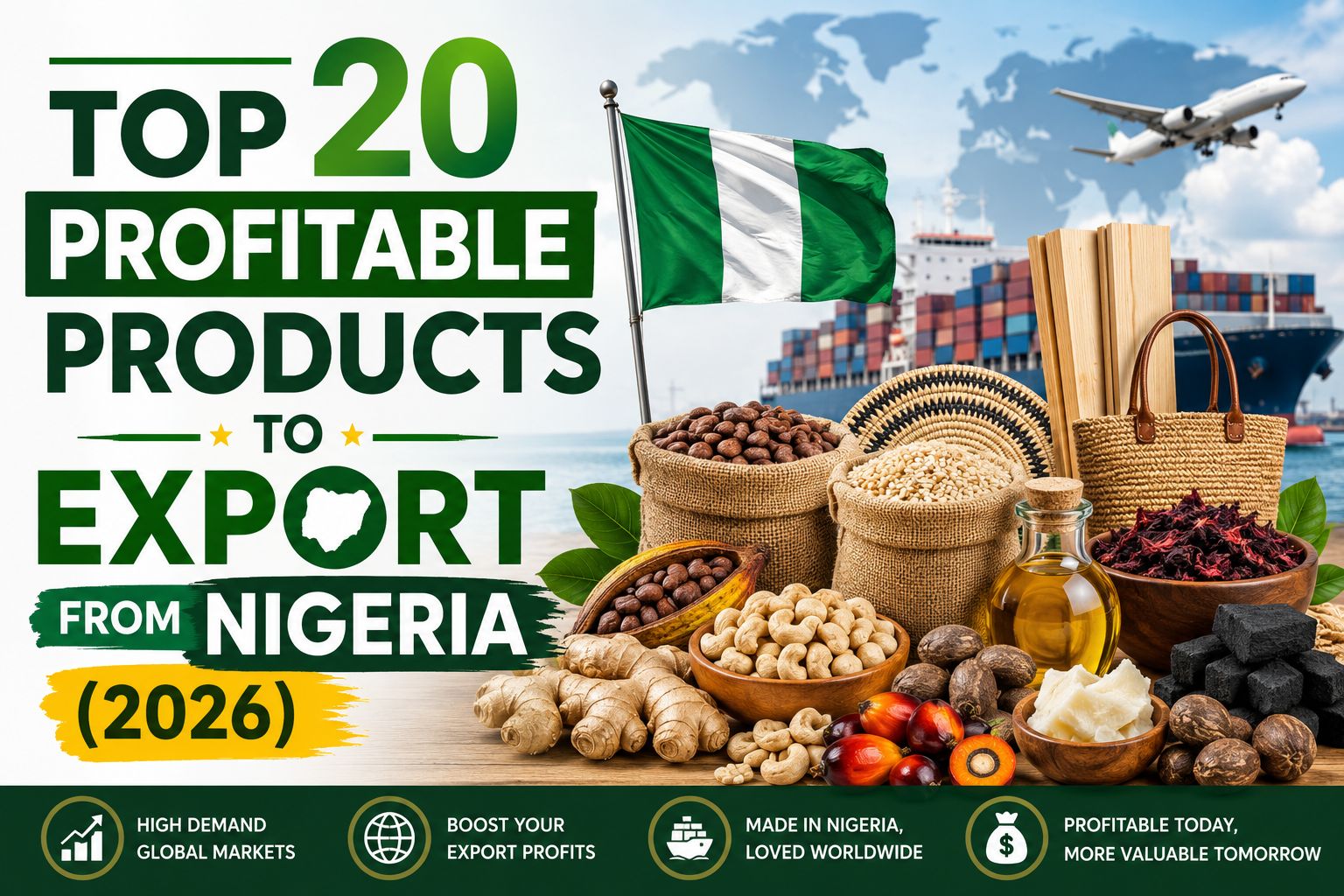
Top 20 Profitable Products to Export from Nigeria (2026)
Table of Contents
- Introduction
- How We Selected These Products
- Nigeria’s Export Landscape in 2025–2026
- Top 20 Profitable Products to Export from Nigeria
– 1. Cocoa Beans (Superior and Standard Quality)
– 2. Urea Fertilizer
– 3. Cashew Nuts
– 4. Sesame Seeds
– 5. Soya Beans
– 6. Natural Cocoa Butter
– 7. Soya Bean Meal and Flour
– 8. Ginger
– 9. Hibiscus Flowers (Zobo)
– 10. Shea Butter (Crude and Refined)
– 11. Frozen Shrimps and Prawns
– 12. Cut Flowers and Foliage
– 13. Aluminum and Copper Ingots
– 14. Rubber
– 15. Gold Doré
– 16. Processed and Packaged Foods
– 17. Natural Personal Care Products
– 18. Leather Goods
– 19. Solid Minerals
– 20. Handcrafted Home Décor
- Value Addition: The Game Changer
- Emerging Niche Products with Strong Potential
- Key Export Destinations for Nigerian Products
- Advantages of Exporting These Products
- Common Mistakes to Avoid
- Expert Tips for Successful Exporting
- Frequently Asked Questions (FAQ)
- Core Lessons
- Actionable Conclusion and Call to Action
Introduction
Yes, Nigeria exported 281 different non-oil products worth a record $6.1 billion in 2025 and the opportunities have never been more diverse. From cocoa beans and urea fertilizer to shea butter and frozen shrimps, the country’s export basket is expanding rapidly.
Read also: How to Start an Export Business in Nigeria (2026 Guide)
The top 20 profitable products to export from Nigeria range from established cash crops to emerging industrial and manufactured goods. Cocoa remains the undisputed king, accounting for 41.11% of total export value in the first half of 2025, while fertilizer exports have surged to rival even agricultural commodities.
This comprehensive guide presents the most current, data-driven list of products you can export profitably from Nigeria in 2026. Whether you are a farmer, entrepreneur, or professional looking to diversify your income, this list will show you where the opportunities are.
How These Products Were Selected
The products in this list are based on:
Read more: 7 Blogging Tips Experts Won’t Tell You Because They Actually Work
– Official trade data from the Nigerian Export Promotion Council (NEPC)
– National Bureau of Statistics (NBS) foreign trade statistics
– Market analysis from reputable sources and industry experts
– Insights from successful exporters and trade analysts
We prioritize products with proven demand, established export channels, and growth potential. The list includes both traditional agricultural commodities and higher-value processed produce
Nigeria’s Export Landscape in 2025–2026
Nigeria’s non-oil export sector reached a historic $6.1 billion in 2025, an 11.5% increase from $5.46 billion in 2024. Export volume rose by 10% to 8.02 million metric tons, and Nigeria shipped products to 120 countries.
The top destinations according to their value were:
– Netherlands (17.53%) driven by cocoa beans, cocoa butter, and sesame seeds
– Brazil (10.35%) major importer of urea fertilizer and agricultural commodities
– India (7.63%) key market for cashew nuts and soya beans
Read also:How I Grew a Blog From 0 to 5,000 Visitors No Ads
In the first half of 2025 alone, non-oil exports hit $3.225 billion, a 19.59% increase compared to the same period in 2024. The volume of goods exported rose to 4.04 million metric tons.
Key trend: Nigeria’s export basket is gradually diversifying from traditional agricultural goods toward higher-value semi-manufactured products, according to NEPC Executive Director Nonye Ayeni.
Top 20 Profitable Products to Export from Nigeria
- Cocoa Beans (Superior and Standard Quality)
Cocoa is Nigeria’s largest non-oil export by a significant margin. In the first half of 2025, cocoa beans alone accounted for 34.88% of total export value, up from 23.18% in the same period of 2024.
In Q1 2026, superior quality cocoa beans generated N596.9 billion, representing 50.91% of all agricultural export earnings. Standard quality cocoa beans added another N1.47 trillion in export value in 2025.
Primary markets: The Netherlands (N228.36 billion), Belgium (N98.56 billion), Malaysia, Canada, and Italy
Why it’s profitable: Global cocoa prices surged by 200% to 300% in just over a year, making cocoa traders the biggest winners in Nigeria’s export sector.
Expert tip: Buyers are willing to pay more for cocoa that meets strict traceability and grading standards. Invest in quality control and certification.
- Urea Fertilizer
Fertilizer exports have emerged as a powerhouse. In Q1 2026, fertilizer exports generated N1.37 trillion, making urea one of Nigeria’s highest-earning export products more than twice the value of cocoa exports during the same period.
In the first half of 2025, urea/fertilizer ranked second among top exports with 17.65% of total export value.
Primary markets: Brazil, India, the United States, and Mexico
Why it’s profitable: Nigeria’s domestic fertilizer industry, led by Dangote Fertilizer Plant (Africa’s largest granulated urea complex with 3 million metric tons annual capacity), has positioned the country as a key global supplier. Approximately 70% to like 77% of output is directed to export markets.
Top companies: Indorama Eleme Fertilizer & Chemical Ltd, Dangote Fertilizer Ltd, and Starlink Global and Ideal Ltd
- Cashew Nuts
Cashew nuts ranked third among top exports in the first half of 2025, accounting for 12.35% of total export value. In Q1 2026, cashew nuts in shell generated N119.76 billion, while shelled cashew nuts contributed N16.69 billion.
Primary markets: India and Vietnam, where most raw cashew nuts are processed before re-export to global consumer markets
Why it’s profitable: Over 80% of Nigeria’s cashew is exported raw, leaving enormous room for value addition through local processing.
Expert tip: Invest in cashew processing to capture higher margins. Shelled cashew nuts command significantly higher prices than raw kernels.
- Sesame Seeds
Sesame seeds ranked fourth among top exports in the first half of 2025, accounting for 4.23% of total export value. In Q1 2026, sesame seeds generated N153.78 billion, making it Nigeria’s second-largest agricultural export.
Primary markets: China (N76.55 billion) and Japan (N21.11 billion)
Why it’s profitable: Nigeria is Africa’s largest producer of sesame seeds and among the top exporters globally. Strong demand from industrial crushing facilities in Asia keeps prices robust.
- Soya Beans
Soya beans (excluding seeds) generated N129.27 billion in Q1 2026, ranking third among agricultural exports.
Primary markets: India (N113.86 billion) and Canada (N11.15 billion) India accounted for approximately 88% of Nigeria’s total outbound raw soya beans
Why it’s profitable: Soya beans and their derivatives (flour and meal) are in high demand for animal feed production, food processing, and industrial applications.
- Natural Cocoa Butter
Natural cocoa butter generated N41.69 billion in Q1 2026, representing 3.56% of agricultural export earnings. It was the highest-ranked processed cocoa product exported during the quarter.
Why it’s profitable: This mid-tier derivative reflects Nigeria’s gradual move from exporting raw beans to providing high-value manufacturing extracts used globally in confectionery and cosmetics.
Expert insight: Export of value-added products such as cocoa butter, liqueur, and cakes reflects Nigeria’s progress in exporting value-added products.
- Soya Bean Meal and Flour
Flours and meals of soya beans generated N53.20 billion in Q1 2026, representing 4.54% of agricultural export earnings.
Why it’s profitable: This product reflects some degree of value addition beyond raw agricultural exports, catering to international animal feed and food processing industries.
- Ginger
Nigerian ginger is widely recognized as one of the best in the world, commanding premium prices in international markets.
Primary markets: Europe, North America, and Asia
Why it’s profitable: Ginger has strong demand for culinary, medicinal, and nutraceutical applications. Value-added products like dried ginger, ginger powder, and ginger extracts offer even higher margins.
- Hibiscus Flowers Zobo
Hibiscus flowers which is popularly (known locally as zobo are becoming increasingly popular in European and North American herbal tea markets.
Why it’s profitable: Hibiscus is fast becoming a favorite in health-conscious markets. It can be exported as dried flowers, tea blends, or herbal extracts.
Expert tip: Hibiscus is actively promoted by the NEPC through export capacity-building programs in states like Adamawa.
- Shea Butter (Crude and Refined
Crude shea (karite) oil generated N9.14 billion in Q1 2026, representing 0.78% of agricultural export earnings.
Why it’s profitable: Shea products are in high demand globally for cosmetics, food, and personal care formulations. Refined shea butter fetches premium prices in Europe and America.
Expert insight: The NEPC actively promotes value addition initiatives such as converting shea nuts into shea butter rather than exporting raw nuts.
- Frozen Shrimps and Prawns
Frozen shrimps and prawns generated N14.30 billion in Q1 2026, representing 1.22% of agricultural export earnings.
Why it’s profitable: Seafood remains an important niche export segment for Nigeria. High-protein maritime products attract premium value and foreign exchange earning potential.
- Cut Flowers and Foliage
Cut flowers and flower buds (fresh/dried) generated N12.23 billion in Q1 2026, representing 1.04% of agricultural export earnings.
Why it’s profitable: Horticultural goods have carved a niche market in Europe and the Middle East. This growing diversification within Nigeria’s agricultural export basket offers opportunities for new entrants.
- Aluminum and Copper Ingots
Aluminum ingots and copper ingots emerged among the top-performing non-oil export products for 2025, according to the NEPC.
Why it’s profitable: Metal recycling and smelting operations have positioned Nigeria as a supplier of industrial inputs. Companies like Metal Recycling Industries (MRI) export ingots worth over $200 million annually.
Top companies: Metal Recycling Industries (MRI) exported $212.04 million worth of ingots in 2024.
- Natural Rubber
Rubber emerged among the top-performing non-oil export products for 2025.
Why it’s profitable: Natural rubber has consistent industrial demand for tire manufacturing, automotive parts, and various industrial applications.
- Gold Doré
Gold Doré (gold in semi-pure form) emerged among the top-performing non-oil export products for 2025.
Top companies: Segilola Resources Operating Limited exported 2,733 metric tons of gold ore worth $151.4 million in 2024.
Why it’s profitable: Nigeria’s first large-scale gold mining company, Segilola Resources, is proving that solid mineral exports are a viable and growing sector.
- Processed and Packaged Foods
Processed and packaged food products offer Nigeria “the strongest near-term opportunity” in the U.S. market under AGOA, according to trade and development policy analyst Dr. Fakunle Aremu.
Products with strong prospects: Spices, flours, grains, snacks, sauces, and shelf-stable ethnic foods
Why it’s profitable: Food products already have market acceptance, particularly among diaspora communities. Exporters must get labelling, traceability, and food safety right.
Expert tip: Spices like turmeric, black pepper, garlic, and chili peppers are experiencing rising international demand.
- Natural Personal Care Products
Natural personal care and beauty products including shea-based items, plant oils, soaps, and haircare formulations are viable exports for the U.S. market.
Why it’s profitable: The global shift toward natural and ethical products works in Nigeria’s favor. Compliance and branding discipline are non-negotiable.
- Leather Goods
Finished and semi-finished leather products such as belts, bags, wallets, and footwear accessories are more competitive than raw hides.
Why it’s profitable: Nigeria can capture more value by exporting finished leather goods rather than raw or semi-processed hides. Quality finishing, standardization, and clear country-of-origin labeling are critical.
Professional tip: The NEPC promotes value addition initiatives such as converting raw leather into finished goods.
- Solid Minerals
Beyond gold, Nigeria has significant solid mineral deposits with export potential.
Why it’s profitable: Industrial minerals like limestone, marble, tin ore, and tantalite have growing demand in manufacturing and technology sectors.
- Handcrafted Home Décor
Handcrafted home décor and lifestyle products can access niche U.S. markets through boutique retail outlets and online platforms.
Why it’s profitable: Nigerian handcrafted products appeal to consumers seeking authentic, ethically sourced items. Uniform dimensions, safe materials, durable packaging, and honest product descriptions are essential.
Value Addition: The Game Changer
A consistent theme across expert analysis is the importance of value addition. Exporting raw commodities leaves significant money on the table.
Consider these opportunities:
– Cashew nuts: Currently, over 80% of Nigerian cashew is exported raw to Vietnam and India for processing. Local processing plants could capture the value created by shelling and grading.
– Cocoa: Processing cocoa into butter, powder, and chocolate generates far more earnings than raw beans.
– Shea butter: Refined shea butter for cosmetics fetches premium prices compared to raw shea nuts or crude oil.
– Ginger and hibiscus: Processing into tea, spice powders, or herbal extracts yields higher profit margins.
> “For the non-oil export segment of our economy to realize its trade potential, we must move from exporting raw goods to exporting finished products, competing on quality and value rather than just price.” Akporee Idenedo, Sterling Bank
Emerging Niche Products with Strong Potential
Beyond the top 20, several niche markets are opening up:
– Spices: Turmeric, black pepper, garlic, and chili peppers are experiencing rising international demand
– Organic products: Many global buyers prefer organically grown food, which Nigerian smallholders can supply naturally
– Floriculture: Ornamental plants and cut flowers are an under-explored opportunity with Europe and the Middle East as markets
– Agro-waste utilization: Products like cocoa husks and cassava peels can be processed into animal feed or bio-products for export
Key Export Destinations for Nigerian Products
Based on 2025 export data:
| Destination | Share | Key Products |
| Netherlands | 17.53% | Cocoa beans, cocoa butter, sesame seeds |
| Brazil | 10.35% | Urea fertilizer, agricultural commodities |
| India | 7.63% | Cashew nuts, soya beans |
| Other destinations | 64.49% | 120 countries worldwide |
Within Africa, Nigeria exported non-oil products to 36 African countries, including 11 ECOWAS states, totaling 1.23 million metric tons valued at $272 million.
Advantages of Exporting These Products
| Advantage | Explanation |
| Foreign exchange earnings | Income in stable currencies (USD, EUR, GBP) |
| Growing global demand | Rising demand from emerging countries such as India, Brazil, Vietnam, and Africa |
| Government incentives | NEPC capacity-building programs, Export Expansion Grant, duty drawbacks |
| AfCFTA market access | Export to 1.3 billion consumers across Africa |
| Value addition opportunity | Processing raw materials dramatically increases profit margins |
| Diversification | Not dependent on Nigerian naira economy |
Common Mistakes to Avoid
- Exporting Raw Commodities Only
Nigeria ranks 130 out of 140 countries on the Economic Complexity Index because the nation overwhelmingly sells raw materials rather than finished goods. Adding value increases margins and competitiveness.
- Ignoring Quality Standards
Buyers demand quality, traceability, and certification. International buyers in the Netherlands and Belgium are willing to pay more for cocoa that meets strict origin and grading standards.
- Neglecting Compliance
“Quality is not negotiable if you want to compete globally.” NAFDAC Director
- Inadequate Market Research
Exporting without understanding your target market leads to unsold products and losses.
- Incomplete Documentation
Documentation errors cause shipment delays, rejection, and financial loss.
- Missing the AGOA Window
Exporters must act quickly to leverage duty-free access to the U.S. market.
professional Tips for Successful Exporting
Tip 1: Focus on Value Addition
> “For the non-oil export segment of our economy to realize its trade potential, we must move from exporting raw goods to exporting finished products.” Akporee Idenedo, Sterling Bank
Tip 2: Start with High-Demand, Low-Competition Products
Emerging niches like floriculture, spices, and processed foods offer opportunities for new entrants before competition intensifies.
Tip 3: Invest in Quality and Certification
Traceability, grading, and certification are essential for premium markets like the Netherlands and Belgium.
Tip 4: Leverage NEPC Support
The NEPC offers capacity-building programs covering export documentation, quality standards, and market access facilitation.
Tip 5: Conduct Compliance Gap Assessments
Before targeting specific markets, assess what you need to do to meet import requirements.
Tip 6: Partner with Established Logistics Providers
Working with experienced logistics companies reduces errors, accelerates learning, and improves operational efficiency.
Tip 7: Explore Multiple Markets
Beyond traditional buyers in Europe and Asia, explore African markets under AfCFTA. Nigeria exported to 36 African countries in 2025.
Frequently Asked Questions (FAQ)
- What is the most profitable product to export from Nigeria?
Cocoa beans have consistently been Nigeria’s most profitable non-oil export, accounting for 34.88% of export value in H1 2025. However, urea fertilizer exports have surged, generating N1.37 trillion in Q1 2026.
- Which agricultural products have the highest demand internationally?
Cocoa, sesame seeds, cashew nuts, ginger, hibiscus flowers, and shea butter are in high demand across Europe, North America, Asia, and the Middle East.
- Can I export processed foods from Nigeria?
Yes. Processed and packaged food products including spices, flours, snacks, and sauces have strong prospects in international markets.
- What are the best export products for beginners?
Products with established demand and relatively straightforward compliance include ginger, hibiscus flowers, shea butter, sesame seeds, and processed foods.
- Which Nigerian products are eligible for AGOA?
Processed foods, natural personal care products, leather goods, and agro-processed inputs are eligible for duty-free access under AGOA, which expires on December 31, 2026.
- How can I add value to raw agricultural exports?
Processing raw materials into finished or semi-finished products significantly increases margins. Examples include: shelling cashew nuts, processing cocoa into butter or powder, refining shea butter, and packaging spices.
- What are the top export destinations for Nigerian products?
The top destinations are the Netherlands (17.53%), Brazil (10.35%), and India (7.63%).
- Is Nigeria’s export basket diversifying?
Yes. According to the NEPC, Nigeria is gradually diversifying from traditional agricultural exports to semi-manufactured products.
- What is the value of Nigeria’s non-oil exports?
Nigeria’s non-oil exports reached a record $6.1 billion in 2025, an 11.5% increase from 2024.
- How many products does Nigeria export?
Nigeria exported 281 distinct non-oil products to 120 countries in 2025.
- What should I consider when choosing an export product?
Consider: product availability, quality standards, compliance requirements, target market demand, logistics feasibility, and value-addition potential.
- How can I find buyers for Nigerian export products?
Use trade fairs, NEPC matchmaking services, online B2B platforms, embassies, and existing exporter networks.
- What role does NEPC play in export development?
NEPC provides capacity-building programs, export incentives, trade linkages, and market access facilitation.
- Is it better to export raw or processed products?
Processed products command higher prices and margins. Nigeria is actively encouraged to move up the value chain.
- What products should I avoid exporting?
Heavy manufacturing, complex electronics, and highly regulated pharmaceuticals are difficult for new entrants due to capital intensity and lengthy compliance processes.
Core Lessons:
- Nigeria’s non-oil exports reached a record $6.1 billion in 2025, with 281 products shipped to 120 countries.
- Cocoa remains the dominant export, accounting for 41.11% of total export value in H1 2025.
- Urea fertilizer has emerged as a powerhouse, generating N1.37 trillion in Q1 2026 more than twice cocoa’s value.
- Value addition is the game changer exporting raw commodities leaves significant money on the table.
- Emerging niches offer opportunities for new entrants: floriculture, spices, processed foods, and solid minerals.
- Top markets are the Netherlands, Brazil, and India, but African markets under AfCFTA represent growing opportunities.
- AGOA offers duty-free access to the U.S. market until December 31, 2026 act quickly.
- Quality and compliance are non-negotiable international buyers demand traceability, grading, and certification.
- Diversification is progressing, but Nigeria’s export basket remains heavily concentrated in a few commodities.
- Government support is available through NEPC capacity-building programs, export incentives, and trade linkages.
Actionable Conclusion and Call to Action
The top 20 profitable products to export from Nigeria span traditional cash crops like cocoa and sesame, industrial giants like urea fertilizer, and emerging niches like frozen shrimp, cut flowers, and processed foods. Nigeria exported 281 products to 120 countries in 2025, generating a record $6.1 billion.
Whether you are a farmer, entrepreneur, or professional, the export sector offers legitimate, scalable, and profitable opportunities. But success requires more than picking a product it demands quality control, compliance, value addition, and strategic market entry.
The window of opportunity is wide open. With AfCFTA unlocking African markets, AGOA offering duty-free U.S. access (until December 31, 2026), and the NEPC providing capacity-building support, there has never been a better time to enter Nigeria’s export sector.
Ready to find your export product and start your journey? Explore more articles on Desuperm.com for in-depth guides on export registration, market entry strategies, and compliance requirements. Subscribe to our newsletter to stay informed about the latest opportunities in Nigeria’s export sector.
Your export journey starts now. Which product will you export first? Let us know in the comments below!